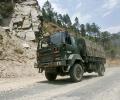
The CAG had taken a strong objection to the long delays by the BRO in constructing 61 strategically important roads.

'Once we deal with the disengagement, there is the larger issue as both of us have brought a very large number of troops up to the border.' 'So there is what we call the de-escalation issue, and then there is the larger, the next step is really, how do you deal with the rest of the relationship?'

India's Foreign Secretary Vikram Misri has arrived in Beijing for a two-day visit during which he will hold talks with Chinese officials. The visit comes amid ongoing efforts to de-escalate tensions along the Line of Actual Control (LAC) in eastern Ladakh and to resume bilateral cooperation in various fields, including the Kailash Mansarovar Yatra.

External Affairs Minister S Jaishankar reiterated India's stance on the Depsang and Demchok areas in Ladakh, stating that Indian security forces will patrol up to the historical limits. He also firmly rejected Nepal's alleged territorial claims, asserting that India's position on the border is clear and will not be altered. Jaishankar also addressed the situation in Myanmar and India's 'Neighborhood First' policy, highlighting the government's commitment to regional cooperation and development.
The Sichuan-Tibet Railway will be the second railway line into Tibet after the Qinghai-Tibet Railway project. It will go through the southeast of the Qinghai-Tibet Plateau, one of the world's most geologically active areas, according to the Chinese official media.

Xi asked about their condition and whether they were able to "receive fresh vegetables" in the inhospitable terrain.

Sources said the Indian delegation was warmly greeted by senior officials of the Chinese Army before the talks began.

He said both sides reaffirmed to sincerely work towards complete disengagement of the troops along the LAC.

The defence minister made the remarks after performing 'Shastra Puja' -- the customary worship of weapons -- at the Sukna-based headquarters of the Indian Army's 33 Corps in Darjeeling district of West Bengal on the occasion of Dussehra.
It is learnt that the India's top military brass is constantly monitoring the evolving situation even as the United States said the aggressive behaviour by Chinese troops was a reminder of the threat posed by China.

According to the 'Military and Security Developments involving the People's Republic of China' report 2023: "Since early May 2020, sustained tensions along the India-China border have dominated the Western Theater Command's attention."
Two days ago, the Chinese foreign ministry following a meeting between NSA Ajit Doval and top Chinese diplomat Wang Yi in Johannesburg claimed that Xi and Modi had reached an 'important consensus' on stabilising bilateral ties at the interaction on the margins of the G20 Summit last November.
Chinese foreign ministry spokesperson Mao Ning told the media in Beijing on Monday that the two sides held an in-depth exchange of views on expediting the resolution of relevant issues.

China said that after this incident both sides are in communication and coordination on the matter through diplomatic and military channels.
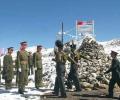
The two sides have already held at least 12 rounds of talks between local commanders and three rounds of talks between major general-rank officials but no positive outcome came out from the discussions, they said.
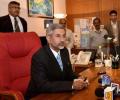
He said the 2 countries have handled border issues in the past.

India said it is strongly committed to ensuring its sovereignty and territorial integrity.

China's Defence Ministry says the militaries of China and India are making "great progress" in implementing the disengagement agreement to end over four-year-long standoff in eastern Ladakh. Spokesman Sr Col Wu Qian said Defence Minister Rajnath Singh and his Chinese counterpart Admiral Dong Jun had a positive meeting in Vientiane, Laos, last week, and the two sides are implementing the settlement reached between the two counties. The two ministers agreed to implement the important consensus reached between the top leaders and promote stable relations between the two countries, the spokesman said.

'Given China's past behaviour and their territorial claims, should we be sceptical regarding China's willingness to adhere to these agreements fully? The answer is yes.' 'As Ronald Reagan famously said in the context of the SALT talks, 'Trust, but verify!' India should also do the same.' 'This has already begun with foot patrolling, drones, satellite imagery and so on. India's military deployment did mirror China's and will continue to do so in the future.'

'They thought nobody would hit Bahawalpur and Muridke because they have nuclear weapons.' 'They used to think India cannot touch our military targets because we are a nuclear weapons country.' 'After Operation Sindoor we have called their bluff.'

In a major confidence building measure, India and China on Tuesday signed an agreement for setting up a mechanism to avert any untoward incident on the border, with Prime Minister Manmohan Singh saying good cooperation between the two countries would bring "great changes" in the world. The agreement was signed after two days of talks between Special Representatives -- National Security Advisor Shivshankar Menon and Chinese State Councillor Dai Bingguo.

'It is typical of China's strategic deception of making virtue out of necessity,' observes Rup Narayan Das.

'Don't be too much after legacy that it should be solved in my lifetime.' 'It is not going to be solved, because you are not dealing with just any other country, you are dealing with a civilisation, a cultural nation.'

Jaishankar said, "The immediate part which awaits us is what we call the de-escalation, which is the build-up of forces along the Line of Actual Control."

The operational alert allows troops to get acclimatised to high altitudes, renovate the bunkers and trenches from which they would fight, break out ammunition, and carry out the coordination needed to fight an integrated defensive battle.
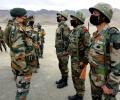
As per the sources, the discussions between the two sides include pulling back tanks and armoured vehicles from their present positions, and some development in this regard is likely to take place in the next few days.

The meeting comes against the backdrop of demands by the opposition seeking details of the violent face-off between Indian and Chinese troops in the Galwan Valley in Ladakh which left 20 Indian Army personnel dead.

China's military on Thursday asked the Indian Army not to take any "unilateral actions" affecting the stability of the border areas, days after the Indian side removed a Chinese-built hut in the Ladakh sector.
The seventh round of military talks between India and China held on Monday was "positive and constructive", and both sides agreed to earnestly implement the understanding reached by their leaders to not turn differences into disputes, a joint statement by the two armies said on Tuesday.

Answering questions on the clashes near Naku La Pass in the Sikkim sector which resulted in injuries to both sides, Chinese Foreign Ministry spokesman Zhao Lijian said that the most pressing issue for the world at present is the fight against the coronavirus.

The Dalai Lama's proximity to the Chinese border will anger the Communist dictators in Beijing, who despise the Tibetan spiritual leader who retains his influence in his homeland 64 years after he fled Tibet.
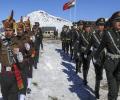
India and China held two days of military talks in an "open and constructive manner" for an early and mutually acceptable resolution of the remaining issues along the Line of Actual Control in eastern Ladakh and agreed to maintain peace on the ground.
The sources said both sides held extensive deliberations on modalities for disengagement of troops from all the friction points in eastern Ladakh at the talks.

Xi arrived at the Nyingchi Mainling Airport on Wednesday and was warmly welcomed by local people and officials of various ethnic groups, Xinhua news agency reported.
The Indian side is expected to present specific proposals at the talks to deescalate tension in Pangong Tso, Galwan Valley and Demchok -- the three areas in eastern Ladakh where the two sides have been on a bitter standoff for last one month, the sources said.

The Indian Army has been matching up to the Chinese build up in both Pangong Tso lake and Galwan Valley, the two locations in Ladakh which have witnessed major reinforcement of troops in the last two weeks, sources said. There was very little chance of easing of tension anytime soon as both sides are aggressively holding onto their respective positions, they said.

The exercises will be held after a gap of one year as both the sides were locked in a 73-day standoff in Doklam in the Sikkim sector of the border in 2017.

The MEA said China has undertaken such infrastructure construction in the past several years and the government too has stepped up border infrastructure which has provided much-needed connectivity to the local population.

Defence Minister Rajnath Singh on Thursday defended the Agnipath scheme underlining that the future of youths joining as Agniveers would not be impacted, even as he said the government was 'open' to bring any change in it 'if required'.
The two sides agreed that the next round of military dialogue should be held at an early date.
